


The final judgement
04 Oct 2026
Duncan Whitty
I don’t know if you have ever visited Paris and the great cathedral Notre Dame. It was off course burned by a fire seven years ago but has been rebuilt and was re-opened in 2024. It is an impressive sight and off course it was built to impress.
The main entrance, the west entrance is impressive and has a big frieze above the door. Here it is:
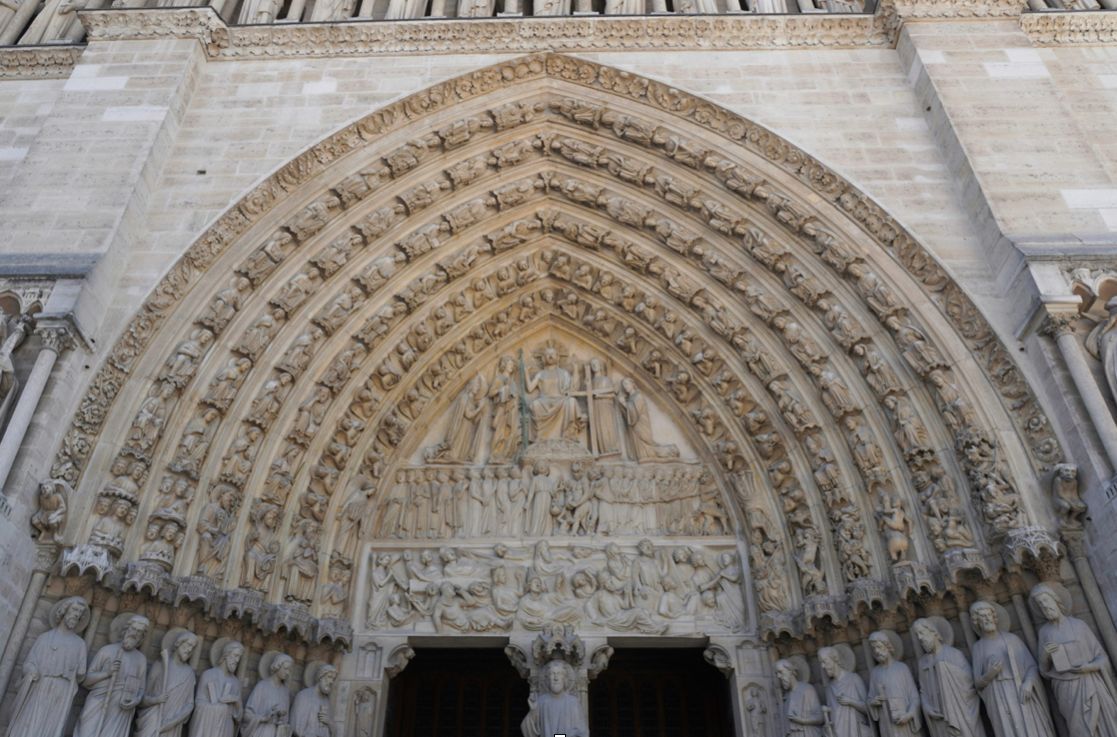
Photo by Aanya Chakravarti on Unsplash
And zooming in we see a bit more clearly the great stone carving of Christ sitting on his throne on the Day of Judgement.
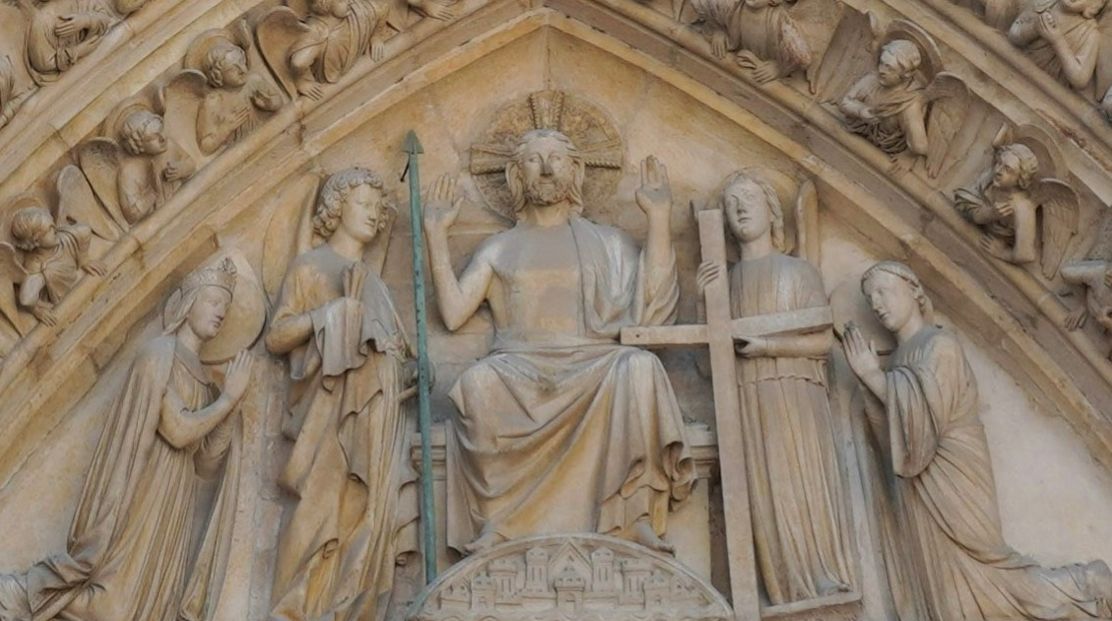
There is his cross carried by an angel and the lance that pierced his side.
And then, beneath Christ you see a row of figures.
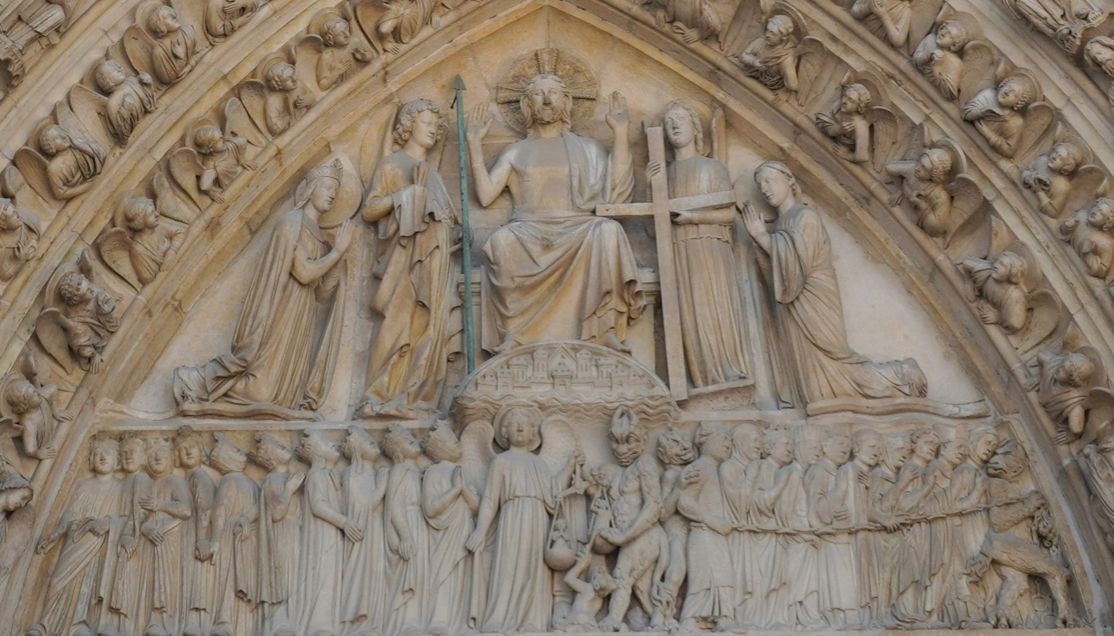
To the right of Christ (our left) are figures who represent the righteous. You see the angel and you see row of figures with crowns on their head. They are those who are found to be righteous on the Day of Judgement.
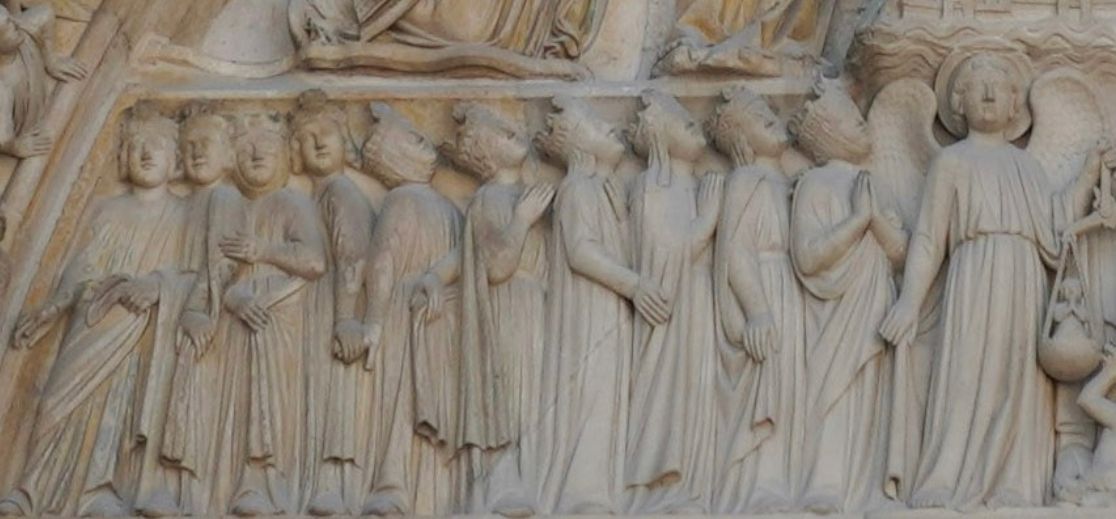
[Photo by Aanya Chakravarti on Unsplash]
And on the left of Christ, (our right), are those who are condemned. They are all in a line with a demon on either end. They have got their backs on Jesus and they are in chains being pulled away.
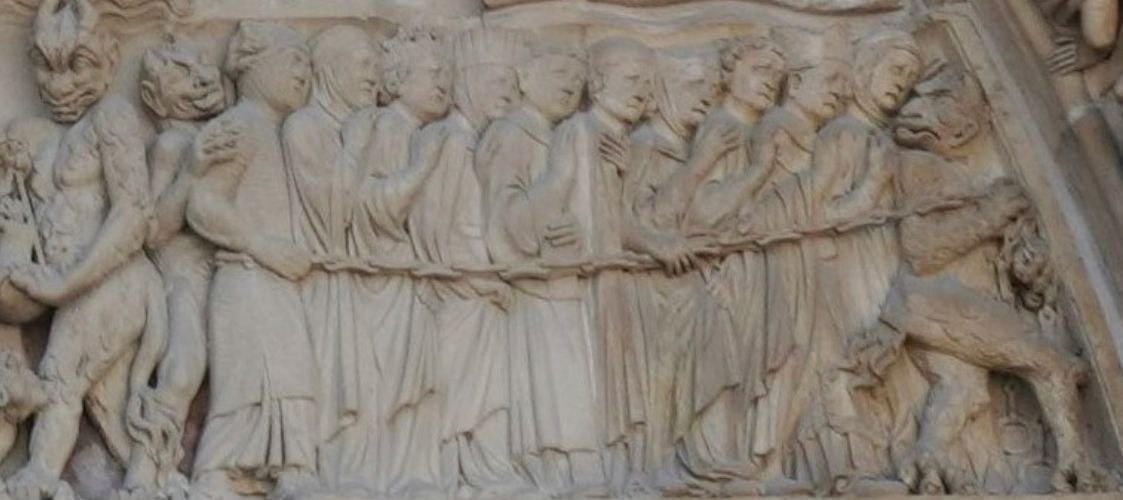
Photo by Aanya Chakravarti on Unsplash
It’s a powerful visual image. All of humanity is split into two groups- those who choose Christ and those who reject him. Those who choose freedom through Christ and those who choose the bondage of Satan. All of humanity, every human is on one side or the other.
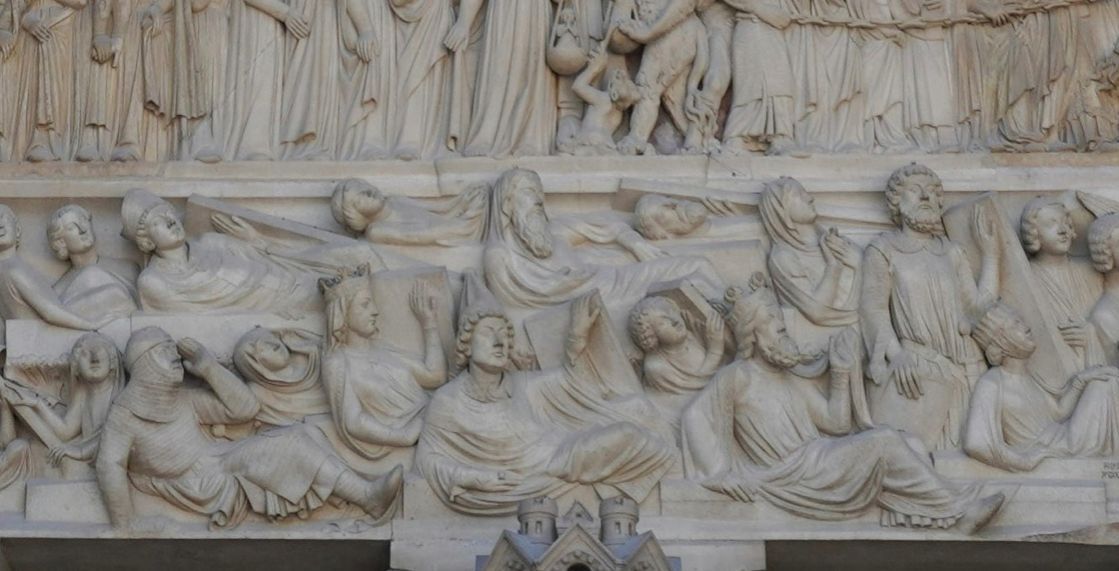
And below we see another image- it is of people coming out of their graves. It’s the resurrection. There is every kind of human being- a king, a queen, a soldier with his helmet on, an African.
This the medieval equivalent of the road side billboard. There are no words, but words are not needed. It’s a huge display that shows people who couldn’t read something that the church really wanted to communicate. It was and is a powerful and public reminder of why it is important to come to church. To prepare for the Last Judgement.
The message was clear, one day you will be resurrected and you will face judgement.
The resurrection of the dead and eternal judgment are two of the basic teachings of the Christian faith that Hebrews 6 mentions. We focussed recently on the resurrection of the dead, today I’d like to talk about eternal judgement. The doctrine that one day in the future, Christ will sit in judgement on all people- giving punishment or reward. A punishment or reward that will stand for eternity. So an eternal judgement. Some will go to eternal reward, others will go to eternal punishment.
It’s an awesome subject and one that nowadays churches often hardly mention. Not many sermons talk about it. It’s certainly not right in your face as it was in the medieval times, where many medieval churches had paintings of the final judgment on the walls- something called ‘doom paintings’ on the walls..
And today it’s a bit of a shock to the system for church goers and especially nonchurch goers to hear about a Day of Judgement. I remember mentioning it once here in my talk and my friend John who was visiting from England said that I needed to do a bit more preparation or explanation of it all, because its not something people think much about.
Many people, sadly Christians included, do not believe in God as acting as our judge. To many Christians they believe in a God of love, but not a God of justice. They believe God is too loving to punish people for wrong doing. Well its true that God is loving, He is love, the perfect representation of love. But as well as being loving the Bible very often describes him as being just. And because he is just, because God loves justice, because God cares about fairness, he will judge wrong doing.
Well this idea of God judging people for their wrong doing is – in our western culture in 2026- very offensive to many people. Many people in Scotland struggle with the fact that God is a God of both love and a God of justice. They believe that a loving God can’t be a judging God. If he is loving, he should forgive and accept everyone and not punish anyone for their wrong doing.
Tim Kellor writes about a discussion he had with a women after a church service in New York. The lady said to him that she felt the very idea of a judging God was offensive.
To which Kellor’s reply was- ‘why aren’t you offended by the idea of a forgiving God?’
And then Kellor went on to make the point that in our Western Culture the idea that God judges people and punishes them is offensive. But Westerners tend to find Jesus teaching about forgiving enemies and turning the other cheek appealing. But in other cultures, in traditional cultures, the teaching about turning the other cheek, about forgiving enemies makes absolutely no sense. It offends peoples’ deepest instincts about what is right. But in these traditional cultures, the doctrine of a God of judgement is no problem at all. We in our culture have more of a struggle with God’s judgement that people in other cultures do.
There is a Theologian called Miroslav Volf, who is from Croatia and who has seen the violence that happened with the break up of the former Yugoslavia as the Croats and Serbs fought each other.
Volf says that the lack of a belief in a God of judgment who punishes those who do evil increases violence in a society. So societies that don’t believe in a God who judges the wicked are likely to be more violent than societies who do believe in a God who will ultimately judge.
When people see their home burned down and their relatives killed and raped, they want revenge. They want a revenge that says ‘you put out one of my eyes, so I will put out both of yours.’ They are pulled into an endless cycle of vengeance, of strikes and counter strikes which are fuelled by the memory of terrible wrongs.
Volf says that belief in a God of divine justice, a belief in a God who will eventually put all things right and settle all accounts, when people have that belief, it means they don’t feel the same need to take justice into their own hands, it gives them the power to refrain from revenge.
In the Nazism and Communism of the 20th century we saw society where the rulers did not believe in a God of judgement and it led to a great deal of brutality. There was no higher power to whom Stalin, Hitler and Chairman Mao had to give account. They thought they would get away with their crimes, their sins.
When people live with the belief in a God of justice, a God who will in the end deal out fair and just punishment, it does put the brakes on their evil.
And so I would argue that not only is a belief in a final judgment true- we have the words of Jesus that say it will happen- it also is a belief that is healthy for society and healthy for people to believe in. It is a restraint on evil behaviour.
I am sure that someone in Paris living in the 13th century who was thinking of stealing his neighbour’s property or abusing his servants might think twice about it when he passes under the great image of Christ in Judgement on Sunday morning as he enters the cathedral. They say ‘there is no one above the law’, and ‘that goes no matter how high you stand, the law is above you’. But in world history national rulers and people with power have felt at times that they are not subject to any law and that they can do what they like.
But imagine the King of France passing under the image of Christ sitting in Judgement in Notre Dame and he looked up and saw the images of the resurrection with kings as well as commoners rising to be judged on that Great Day, it must have caused him to reflect and think ‘yes there is a law and a law giver who is above me. One day even I will have to give an account for what I have done before a judge.’
You know on the news this week was the fact that hundreds of prisoners in the UK are being released from prison early. It is because the UK doesn’t have enough prisons to house all our criminals. I’m sure some victims of those who have been stolen from or been attacked or suffered domestic abuse aren’t happy about that. It doesn’t seem fair. And every year there are many crimes where the police never even find the criminal. We think ‘well its not fair that they are getting away with it.’ But they won’t. One day they will have to face the ultimate judge.
Maybe we have had injustice committed against us. It didn’t seem fair when the laws in Hong Kong were changed after the handover from the UK to China and promises were broken. Many Hong Kongers rightly feel the government in Beijing wasn’t fair or honest.
We all have an inbuilt sense of justice from a young age. We want justice. A child when he or she gets fewer sweeties than his brother or sister notices immediately the injustice and says ‘its not fair’. We all have a sense of justice, fairness. That is a reflection of God- who has a much more sensitive and accurate sense of justice than we do.
The reality of the final judgement tells us that in the end no one will get away with it- in the end everything will be fair and just. Everyone who has done wrong will be punished on that great Day.
It shows us that this universe in which we live is a fair universe.
So John who wrote the book of Revelation was given a vision by Jesus of the Day of Judgement. John saw a great white throne and he saw a person seated on it. The Earth disappeared and so did the sky, the heavens. It appears the physical universe comes to an end on that Day. And John saw the dead, great and small, the presidents, kings and rulers and humble poor, everyone standing before the throne. All the billions of people who have lived on this Earth were before the great throne. You and I will be standing there one day, your family members, every person you have met.
And books were opened. That is symbolic of the record that God has of all our lives. God has a complete knowledge of everything that we have ever done, ever said and even thought in our lives. He knows it all. Its all been recorded. The good and the bad.
That is a very sobering thought in itself. To be confronted by a book in which everything you have felt, thought and said has been recorded faithfully, accurately, honestly and impartially. I don’t think any of us would want to show on that screen for the whole congregation to see our thoughts and attitudes this week. The unkind thoughts and the angry and the selfish ones as well as the better ones. None of us would like a recording broadcast of the words we have spoken. Jesus said that the things we whisper in our bedroom will one day be shouted from the rooftops. In other words on that great Day its all going to come out into the open. That in itself is a challenging thought.
Now when God is opening the book of your life- it is not to see if you have enough good deeds to cancel out your bad deeds. Many people think they are good people and will be acceptable to God because of their goodness. Because they have done more good in their life than bad. They think they have basically done enough good deeds to make themselves ok in God’s sight. I would say that is the view of most people in the UK who believe in God’s existence.
But as far as the law is concerned, it does not matter how many times you have kept it, what the judge is concerned about is have you broken it?
Supposing I was driving to church this morning and I went along the Edinburgh bypass too fast and I was caught by a police trap and told to pull over and the policeman comes over and says to me that I was speeding. Now if I was to say to him, ‘but officer, I stopped at every traffic light and I kept my speed down when I was in Haddington’, that is not going to impress him. I still broke the law!
Now supposing you only did one bad thing every day. You only sinned against God, you only broke God’s law once per day. Now we probably do much more than that, but let’s imagine we are good enough to only sin once a day. We here have all here lived thousands of days- that’s thousands of sins.
What is a sin? A sin is time we break God’s law. We have all broken God’s law many times. That is the reality we all have to face. We are all guilty.
In Romans 2 we read that God judges us according to what we knew to be right.
So for people who have never heard about Jesus Christ, don’t know about the Bible and don’t know the 10 Commandments, they will be judged according to the amount of truth they had. Everyone has been given a conscience by God. We all have a moral compass that tells us right from wrong. Those who don’t know the true God, the God of the Bible, will be judged according to whether they lived up to, what they knew to be right, what their conscience told them. Nothing can be fairer than that. But there is not a human being who has ever done that fully. We all have gone against the voice of our conscience. There is not a human being who could look you in the face and tell you that they have lived up to what they knew to be right all the time. That they have always followed the light as far as they could see it.
So in other words there is not a human being who can say anything other than ‘guilty’ on that day. Not one.
And since God is a God of justice he will execute judgement. And that judgement is called the second death. It is to be thrown into the lake of fire.
As Pawson puts it- the first death which everybody has to go through separates us form men and from earth. The second death separates us from God and from heaven. It is the second death that is the bad one- because it is an eternal separation, for ever. It is final and terrible. I will say no more about it.
But thank God there is another book. And that book is a book of names. It is a list of all the people who trusted Jesus. It is called the book of life, or later on it is called the Lamb’s book of life.
The Lamb is a name for Jesus. This is Jesus’ book. It has his name on it. Only those who have their names written in his book will get life.
There has only ever been one human being out of all the billions who have ever lived who has lived 100percent right in thought, word and deed every day without fail. There is only one life in which there is recorded in it not one single sin. Not one. The book of Jesus’ life has not a single sin in it. Jesus alone out of all of us has been good. And he suffered great temptations and great pressure and suffering, but he lived right all the way through.
Therefor across his book is written the word ‘life’.
Every person who has ever put their faith in Jesus, who trusts in Jesus, who believed and went on believing in Jesus and showed it by their life has their names in that book.
When a person believes in Jesus, Jesus’ goodness gets ascribed to them. And their name is in the book.
Jesus said ‘whoever hears my word and believes him who sent me has eternal life and will not be condemned, he has crossed over from death to life.’ John 5:24.
Paul says in Romans chapter 8 ‘there is now no condemnation for those who are in Christ Jesus’.
That means that on the Day of Judgement, although we who believe in Jesus deserve condemnation, we won’t be condemned, we will be acquitted. We need not fear that great Day, because we are Christ’s.
Isaiah 53 tells us about Jesus and his death on the cross. That he took our punishment that we would otherwise be given. The punishment we deserve to be given, he has already taken.
Isaiah says:
He was pierced for our rebellion,
crushed for our sins...
The Lord laid on him
the sins of us all…
And because of his experience,
my righteous servant will make it possible
for many to be counted righteous,
for he will bear all their sins…
He was counted among the rebels.
He bore the sins of many and interceded for rebels.
Jesus has born our sins and the sins of the world. Every evil thought, word and deed of our whole lives.
When we believe in him, which means really trust him and surrender our lives into his hands, then we cross over from death to life. We receive the benefits of what Jesus has done for us. We are counted righteous in God’s sight. We are counted worthy of entering the kingdom to come. Because he was counted amongst the rebels on the day of his suffering, we will be counted righteous on the Day of his Judgement. Our names will be found to be in the Lamb’s book of life. We will not perish, we will not experience the second death.
John 3:16, For God so loved the world that he gave his one and only Son, that whoever believes in him shall not perish but have everlasting life.
Is your name in that book?
There is an old hymn that has these words:
O happy day, that fixed my choice
On You, my Saviour and my God.
It is done, the great transaction’s done
I am my Lord’s, and He is mine.
There is a transaction that must be done for your name to be written into that book. It’s a transaction between you and Jesus. It is a choice that you and every person must fix, must make, to choose Jesus to be your Saviour and God. When it happens, when you fix your choice on him, then a great transaction is done with God and you can say I am my Lord’s and He is mine.
Only those who are his will stand on that Great Day.